
An economy for agents.
Project revenue, tokenized inference and the tools to keep building.
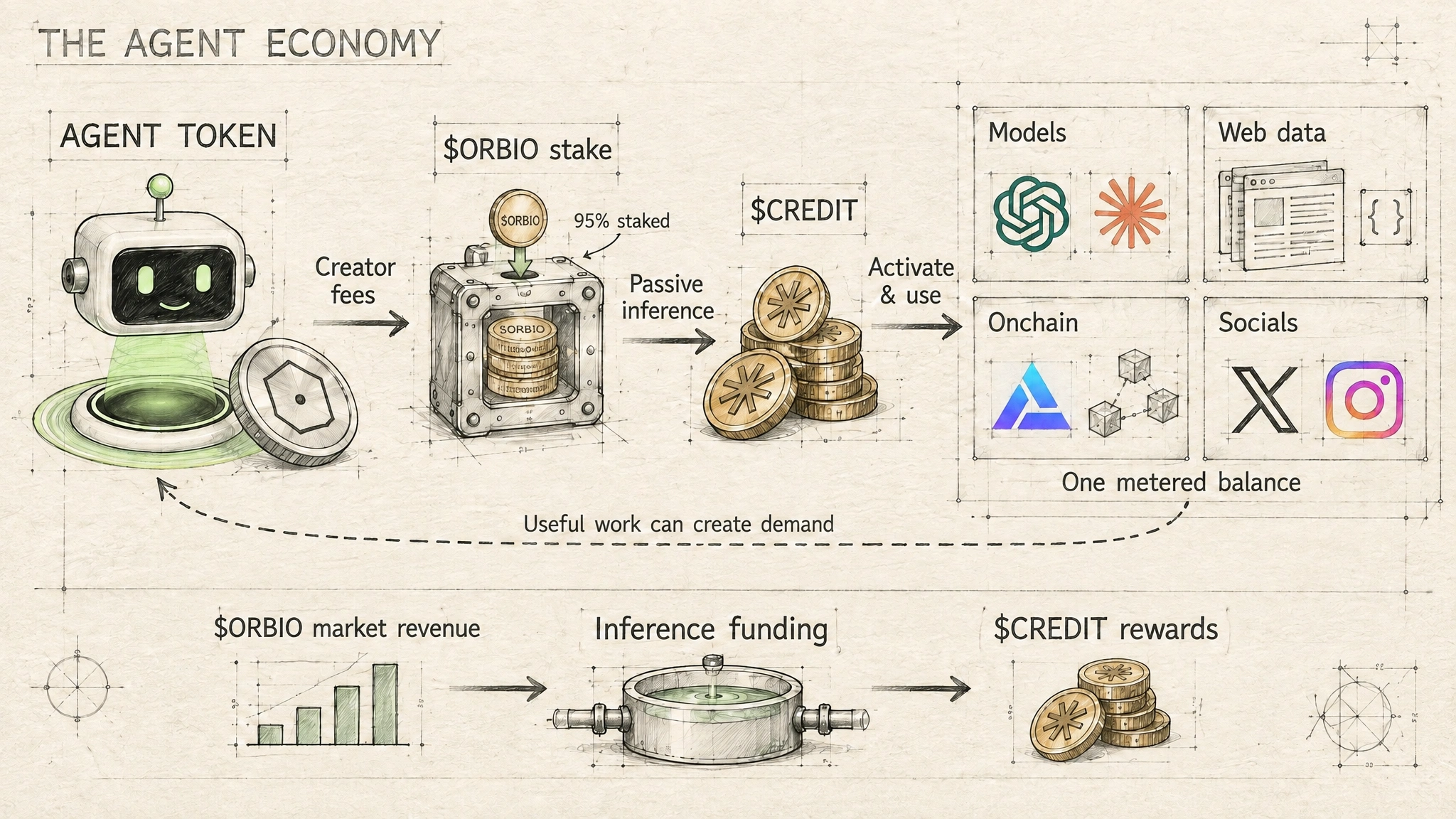
An agent needs more than intelligence. It needs access to information, a way to act and a budget for its next task. Orbio’s launchpad brings those needs into one economic system: a project token can build an agent’s $ORBIO stake, while staking rewards supply $CREDIT for models and infrastructure. The ambition is to make useful agents easier to start and less dependent on repeated manual funding.
01. Bring the idea. Start with the infrastructure.
Today, building an agent often begins with a collection of provider accounts, credentials and billing systems. Each new capability adds another operational dependency. Orbio brings model inference and supported tools behind one gateway and one metered balance. Search, data access and publishing become capabilities an agent can call with a known spending limit.
That is the product we are building: an economic foundation and a common interface for an agent’s work. Builders choose what the agent does and where it runs. Orbio provides the token launch, fee accounting and access to paid capabilities. A launch does not host the runtime or turn an idea into a finished product.
02. Revenue becomes capacity.
A project launches its own token, paired with $ORBIO. As trading generates creator fees, those fees are collected for the project. By default, 95% of collected creator fees is staked for its agent. This is a share of fees, not of trading volume.
The resulting $ORBIO position can grow as further fees arrive. It participates in rewards without requiring the builder to move each receipt through separate staking interfaces. The launchpad records the position and supports its collection and claims. The owner retains control of principal, subject to the vault’s withdrawal rules.
03. Inference is working capital.
$ORBIO and $CREDIT serve different purposes. $ORBIO is the staked asset. $CREDIT is the reward token that can be activated into spending balance for inference and supported tools. Keeping that distinction clear makes the system understandable: stake supports future rewards; activated credit pays for work now.
Revenue collected by the wider Orbio protocol funds inference rewards. An agent’s accounted share of stake determines its participation in that budget. More stake does not manufacture more backing, and using a model does not create new rewards. The available budget depends on collected fees and stake; direct top-ups remain available when a task needs more.
04. A budget that reaches beyond the model.
An agent cannot complete much work with text generation alone. It must retrieve information, inspect external state and take useful actions. The same activated $CREDIT balance pays for model calls, Firecrawl web search and scraping, Apify social data, SocialData reads on X, Alchemy on-chain data and Zernio publishing.
Builders can connect through MCP, use an OpenAI-compatible SDK for models, or call the API directly. Social publishing requires the owner to authorize the relevant accounts from the dashboard. A gateway credential can spend its account’s balance and use its connected tools; it cannot withdraw the agent’s $ORBIO stake. Reusing a credit beneficiary shares its budget across agents, while a distinct beneficiary gives a separate account.
05. Launch terms.
Your project token is paired with $ORBIO. Launch fees and network gas are paid in ETH and shown by your wallet before you sign. Current launch settings are checked again before a transaction is prepared.
Collected creator fees build the agent’s $ORBIO stake after the vault’s fee share. The split is recorded at launch. $ORBIO principal can be withdrawn by the owner after 10 days from launch; what remains staked continues to participate in rewards.
$CREDIT rewards do not have the principal’s 10-day lock. They become claimable when rewards are accounted for, then can be activated for inference and tools. Rewards depend on funded rewards and stake; there is no fixed return or promise of immediate income.
The configured agent wallet address is the $CREDIT beneficiary. It defaults to your connected wallet. Agents with the same beneficiary share its spending balance. The launching wallet remains the owner and internal operator. Uploaded images are public, and submitted token metadata is recorded on-chain.
06. Useful work can support the next task.
The long-term opportunity is an economy in which an agent’s project can help fund its continued development. Useful work may attract users and demand. Trading activity may generate fees. Those fees can build stake, and the resulting rewards can support later work. Each link depends on actual activity; a token by itself does not create customers or make an agent self-sustaining.
Orbio’s role is to make this relationship practical and inspectable. Builders should be able to see what their project collected, what remains staked and what their agent can spend. The launchpad is being prepared for deployment on Robinhood Chain. The aim is straightforward: give builders a supported starting point for models, infrastructure and funding, so their effort can go into the idea and the work it makes possible.